
An Archipelago of Kakanin
By Gwyneth King · August 22, 2026
It’s safe to say every Filipino’s childhood includes some form of kakanin. For me, kakanin first entered my consciousness as puto calasiao peddled on the street, packed in a tiny brown paper bag that my family would buy on our way to school. Some 20 years later, this memory resurfaces on a drive with my boyfriend to a local mall, where we spot a vendor selling the nostalgic puto calasiao along Gilmore Avenue, just after the intersection at Aurora Boulevard. We both squeal in delight—because that’s when we discovered puto calasiao was a memory we shared, despite having two completely different childhoods.
Of course, kakanin doesn’t stop at puto. A different kakanin may characterize a different childhood: the OPM band Ben and Ben sing about bibingka in a Christmas tune set during Simbang Gabi: “Ang sabi nila / Bilhan mo na siya ng bibingka.” Perhaps the most common kakanin variants, puto and bibingka, show the primary methods of cooking kakanin—steaming and baking, respectively.
What makes kakanin, kakanin?
At their core, kakanin, or glutinous rice cakes, are made from two ingredients: glutinous rice, or malagkit (sometimes other grains and root crops are used), and coconuts, both abundant in the Philippines. In the hands of Filipinos, malagkit becomes galapong (rice batter), and glutinous rice flour, and coconuts become kakang gata (coconut cream), gata (coconut milk), latik (coconut curds or syrup), and niyog (coconut meat). From there, Filipinos turn these ingredients into delicacies of all sorts of shapes, sizes, and colors.
The Philippine Heritage Kitchen, founded and curated by Chef Reggie Aspiras, in partnership with CCA Manila, hosted the kakanin festival Kakanin Kanin! last August 22 at the Glasshouse at New World Makati, bringing together makers and eaters all in one place to celebrate our kakanin culture and heritage.
The kakanin craftsmen make a showcase
Artisans from CALABARZON, Region I, III, VII, X, and NCR left their hometowns in the spirit of kakanin, traveling the distance to demonstrate their long-standing kakanin recipes and share their stories with an eager crowd. Meden Verano from Los Baños found herself teaching culinary professionals years after switching from culinary studies to agricultural studies because of budget constraints. “Pwede pala pagsamahin yung culinary at agriculture,” shares Verano, who’s become a part of the Philippine Rice Research Institute (PhilRice). She demonstrated how to make the colorful Sapin-Sapin, which often comes in a bilao, and Tikoy sa Tukil, which is made from steaming a mixture of galapong with eggs, flour, sugar, condensed milk, and butter in a bamboo tube referred to as “tukil.”
Chef Reggie Aspiras, who hails from Agoo, La Union, invited an artisan so dear to her childhood — 80-year-old former barangay captain, Maria Esmena “Ante Marie” Valdez, also known as the “binubudan queen” to many — to make her favorite binubudan. Unlike most kakanin, binubudan is fermented rather than cooked and uses rice yeast, or bubod, which comes in a disc-shaped cake from Rosario, La Union. The delicacy comes out as a porridge-like rice dish with an astringency from the rice wine produced during fermentation. Meanwhile, Chef Xavier Mercado of La Union’s celebrated Halo Halo de Iloko demonstrated his own kakanin creation — Fried Champorado, cased in a lumpia wrapper, fried like turon, topped with ice cream.
Chef Dorjan Reyes of Casa Zaragosa introduces the Pateros-born inutak, named for the kakanin’s resemblance to a brain, or “utak.” The galapong mixture is cooked into a paste, split into two, flavored with ube halaya, topped with thickened coconut cream and baked bibingka-style — using charcoal to bake the dish from top and bottom. The result is a sticky, gloopy, two-layered rice pudding with a glossy, golden crust and singed bits that give the kakanin its name.
While several kakanin dishes, like suman, use banana leaves as packaging, Bukidnon’s Binaki differs by using corn husks as its wrapper. Inang’s Delicacies has produced binaki since the 1980s, and artisans Linda Tasani and Norly Pepito demonstrate the recipe they inherited from their mother. Two stories trace back to binaki’s origins. The Ilocano word “baki” translates to “frog,” referring to the earlier method of wrapping the delicacy in a V-shape that resembles a frog’s open legs, while another story says the dish's etymology stems from the posture formed when grating the corn. Naturally, the dish is made from corn, which they grate, blend, and combine with sugar, milk, butter, eggs, and baking powder, and steam in the corn husks that also act as the wrapping. Binaki takes on suman’s familiar longitudinal form, containing a steamed corn cake with a bite that resembles a soft muffin, and is best paired with a hot drink like tea, coffee, or sikwate.
The provinces of the Philippines, presented as kakanin
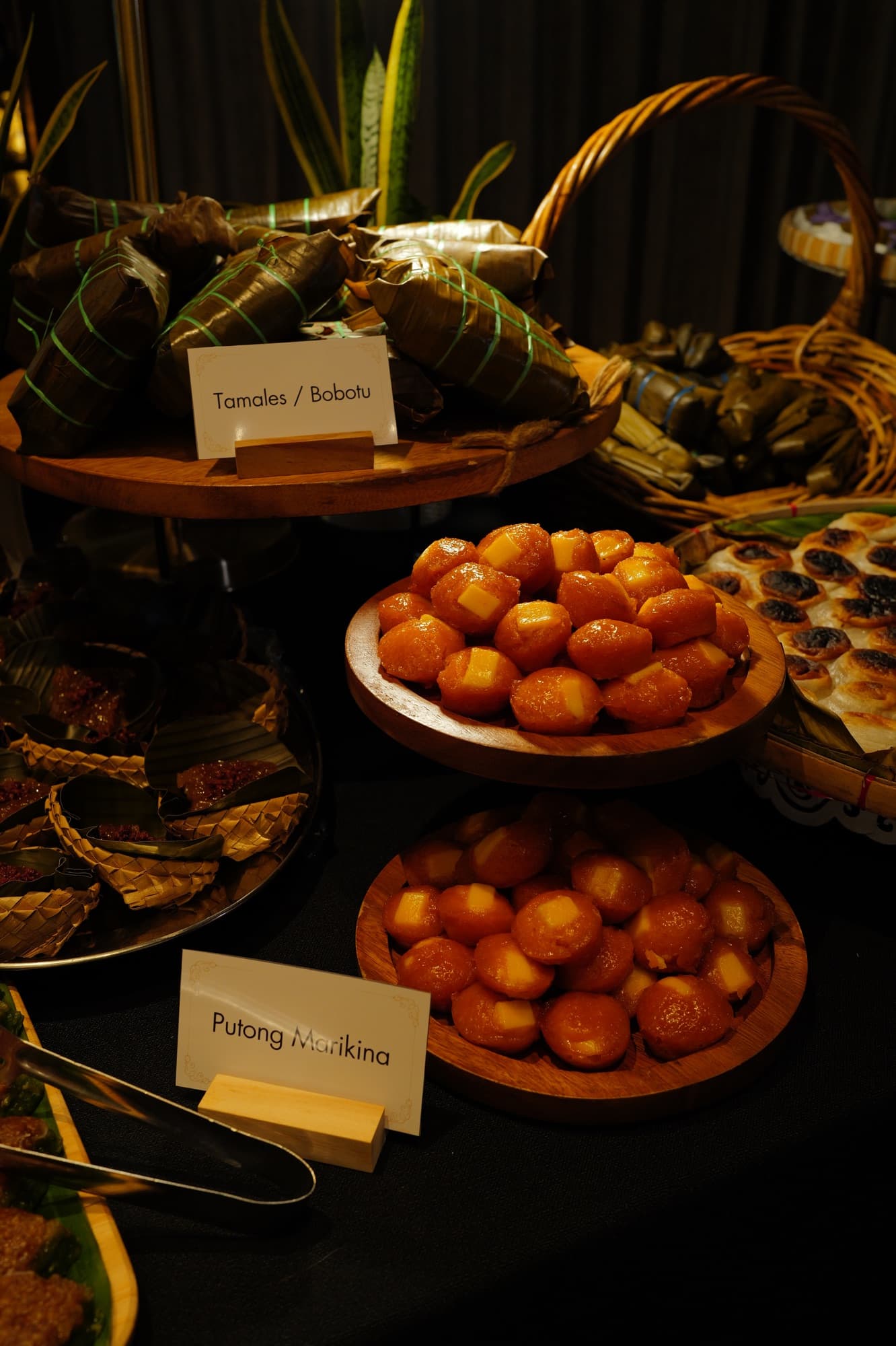
After lunch came the kakanin buffet, like no other — Kakanin Kanin! was the first in the Philippines to bring kakanin culture to this scale. There were over a hundred kakanins laid out beautifully in the Glasshouse from all parts of the Philippines: binungey from Pangasinan laid out in bamboo tubes, triangular tamales from Bulacan, tikoy sa anahaw from Quezon wrapped like mini-bouquets, deep violet puto bao from Los Baños, and bilaos filled with bibingka, palitaw, and so much more. Chef Reggie Aspiras, who is the founder and curator of Philippine Heritage Kitchen, dedicated a hearty and nostalgic merienda spread dedicated to her mother, Amparo Apiras, inspired by the meals of her childhood — featuring heirloom pancit palabok, Agoo dinuguan, kalabasa arroz caldo, Lola’s binignit, Candon Calamay, sago’t gulaman, among others, which was the perfect savory touch to balance out the carb-rich buffet.
Would you believe that this is only a fraction of all the kakanin served?
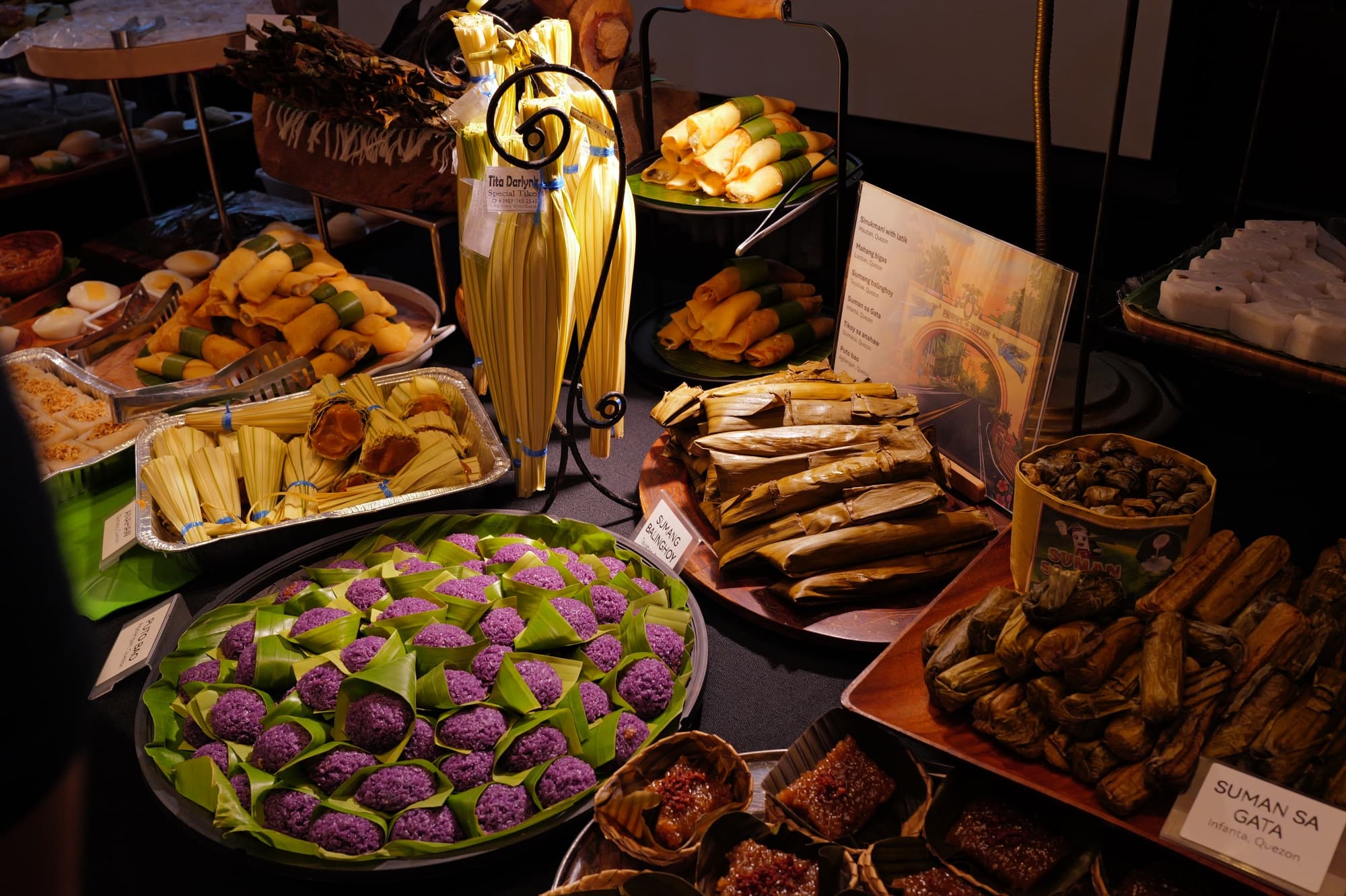
Beyond food traditions, kakanin persists because of the Philippines’ merienda culture—having lighter snacks mid-day to tide off hunger until the next heavier meal. It’s a tradition that has translated across sectors: one might find their go-to kakanin at a commercial chain like Dolor’s Kakanin or Lola Nena’s, while others may find comfort in home-cooked dishes or seek out kakanin from heritage artisans.
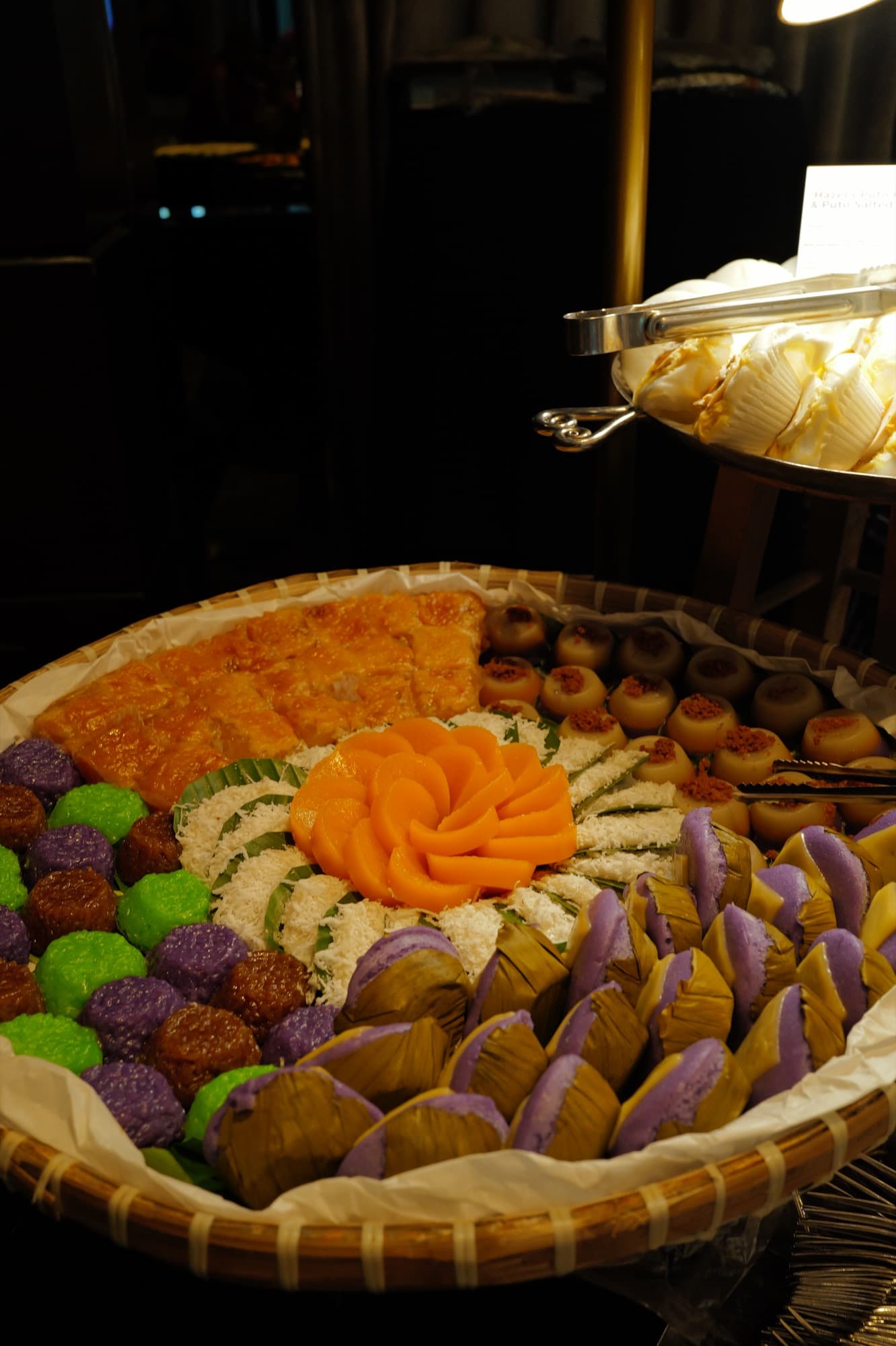
Kakanin is also an art form — like this bilao of kakanin that is a feast for the eyes and the mouth.
The Philippines’ archipelagic culture reveals its beauty in facets such as our snack gastronomy, where kakanin, despite having two foundational ingredients, can differ greatly depending on where you’re coming from — one might be snacking on gelatinous inutak in Pateros, while another could be enjoying sticky budbud kabog in Cebu.
While the puto may be considered a common kakanin, you’ll find that provinces often bring their own version to the table.
The Philippines has over a hundred versions of kakanin, made by all kinds of people from all provinces. How lucky were we to experience kakanin in abundance, all in one afternoon?
Meet the makers
Los Baños
- Meden Verano
- Elvira Formeloza
Sapin-Sapin · Tikoy sa Tukil
Region I
- Chef Ryan Cortez
Binungey
Region I
- Chef Xavier Mercado
Fried Champorado · Buyos/Tupig
Region I
- Maria Esmeña Valdez
Binubudan
Pampanga
- Ruston Banal
Tibok-Tibok
Pateros
- Chef Dorjan Reyes
- Angeli Chin
Inutak
Bukidnon
- Linda Tasani
- Jocelyn Ones
Binaki · Suman
Rizal
- Chef Anne Atanacio
Hibok-Hibok ng Rizal · Pitchi-Pitchi · Kutsinta
Cebu
- Chef Richard Hao
Puto Buli · Titik Budbud
Culinary Eco Life
- Super Manang Jessabel
Easy Bibingka